
All about plywood: MR, BWR and BWP grades
Fixed furniture has been winning over loose furniture for decades, and plywood is why. It costs less than solid wood, it keeps the look of timber, and it does not shrink or warp the way a solid plank will. But "plywood" is not one material, and choosing the wrong grade is one of the more expensive mistakes you can make in a kitchen.
What plywood actually is
Thin sheets of wood — plies — glued together under heat and pressure into a flat sheet that is strong, stiff and slightly flexible. The plies are laid with their grain alternating direction, which is the whole trick: it stops the sheet moving the way a solid board does as humidity changes.
You will find it in roofs, floors, wall sheathing, cabinets and wardrobes, in hardwood and softwood, with a wide choice of facings.
The three grades worth knowing
There is a lot of plywood on the market, classified by wood type, process and application. For interior work, three grades cover almost everything.
MR — Moisture Resistant
What your local vendor will call commercial ply. Resistant to moisture, but not waterproof — an important distinction. It is the standard choice for cabinets and general interior furniture in dry conditions.
BWR — Boiling Water Resistant
For anywhere water is likely: kitchens above all, and homes in damp climates such as the coastal regions. It is made with 'A' grade phenolic resins or phenol formaldehyde adhesive, which is what gives it its water resistance. BWR sheets come warp-free with no surface gaps, and handle water considerably better than MR.
BWP — Boiling Water Proof, or Marine
Built for ship-building, hence the name. Treated with high-grade melamine and phenolic glues that let it resist boiling water temperatures for up to 12 hours, and give it its anti-warp properties. In a house it belongs in exterior applications, or anywhere that will genuinely get wet. Stronger than both BWR and MR.
| Grade | Water behaviour | Use it for |
|---|---|---|
| MR | Resists moisture, not waterproof | Wardrobes, general cabinetry, dry rooms |
| BWR | Resists boiling water | Kitchens, bathrooms, humid and coastal climates |
| BWP / Marine | Waterproof, up to 12 hours boiling | Exteriors, anywhere genuinely wet |
The properties that matter on site
Strength. Plywood holds a screw well without splitting or breaking out — which is exactly what fixed furniture asks of it.
Stability. The alternating grain plus the adhesive make it more stable than a standard board. It resists expansion and contraction, and absorbs or releases far less moisture than ordinary wood. Sheets are separately graded A to D for surface quality, A being the best.
Flexibility. Unlike real wood you are not limited by the size, form or appearance of the tree. It comes in a range of thicknesses and facings. Strength and flex are set by the number of plies, always an odd number — 3, 5, 7 — because an odd count keeps the sheet dimensionally balanced.
So which one?
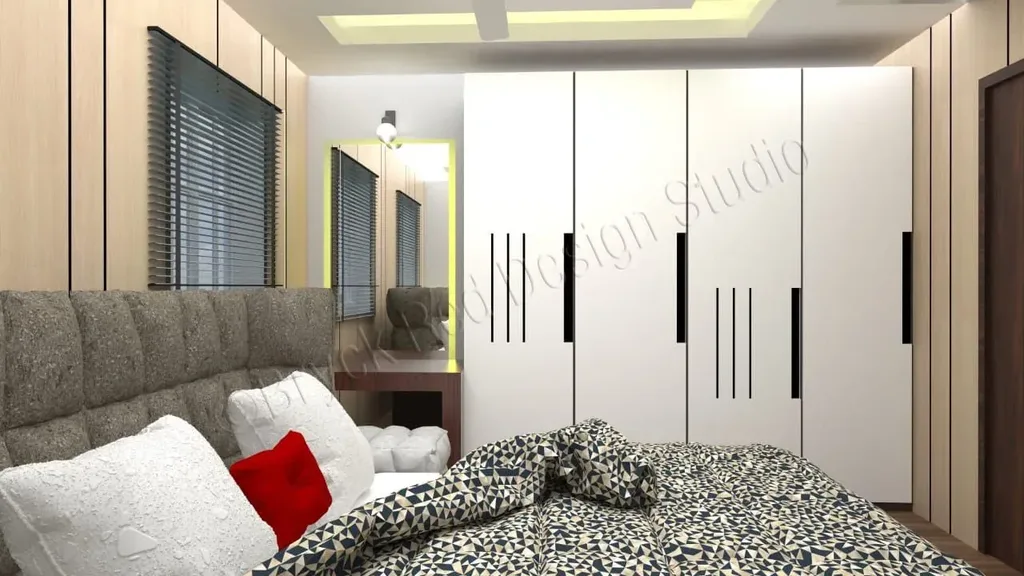
Work backwards from water. A kitchen or a house in a humid coastal belt wants BWR at minimum. Bedrooms and living rooms, with no real exposure, are perfectly served by commercial MR ply — and paying for marine grade there is money that would do more good elsewhere in the room.
If you are weighing plywood against the cheaper engineered boards, that is a separate decision with its own trade-offs — we have written about the alternatives and where each one fails.